Kaaps is one of the oldest languages in South Africa. From precolonial roots and colonialism to our current post-apartheid conditions, activists, academics, artists, and authors continue to campaign for the empowerment of Kaaps speakers in influential contexts such as schools, universities, social life, politics, and the economy of our country. But what has been happening lately?
Before the Covid-19 pandemic, most people inside and outside South Africa would not have given a second thought to Kaaps, its development as a language, its prestige (or image) or the significance it holds for its speakers. Today, this language is used in the South African Parliament, increasingly on radio and television, and in other influential contexts. Over the last two years alone, there has been an increased focus on and production of research, as well as academic and creative writing on the following: the history of Kaaps; the social life of Kaaps in contemporary times; the general linguistic description of Kaaps; the development of the writing system and formalisation; the educational advancement of Kaaps for academic literacy in both basic and higher education; and the political, media and economic benefits of Kaaps.
There have also been several significant strides in the formalisation of Kaaps through its inclusion in higher education language policy and further corpus development. The University of Cape Town has included Kaaps, amongst other indigenous languages, in its revised language policy. A significant step towards linguistic justice for historically marginalised speakers. The first Grade 6 Natural Science and Technology materials in Kaaps have been produced and are currently being tested in a school. They are freely available for download here.
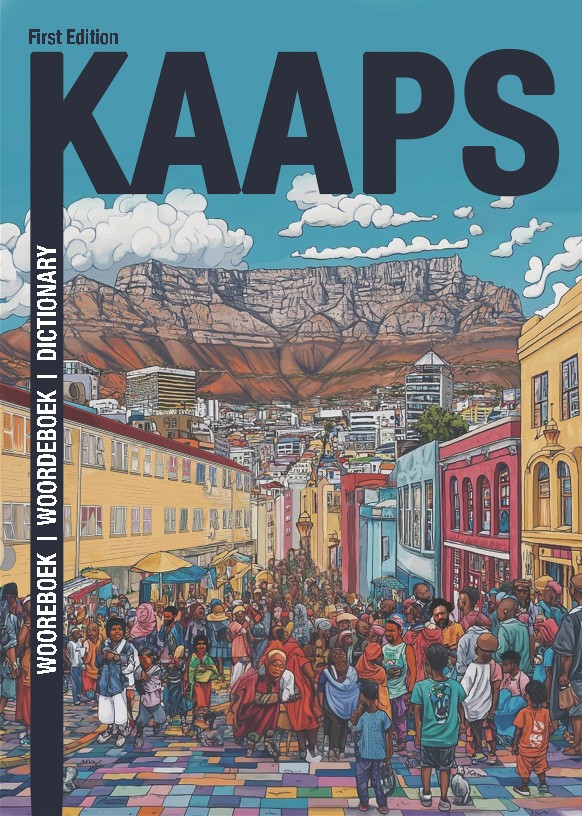
A historical milestone is about to be reached. The first Kaaps dictionary is scheduled for publication in print in October/November. The dictionary will be a reference resource for every multilingual speaker in South Africa. Its publication marks an important step in advancing the empowerment of Kaaps speakers, while also contributing to the transformation of prevailing negative attitudes and perceptions about Kaaps as a language.
The Kaaps Dictionary is published in collaboration with the Centre for Multilingualism and Diversities Research (CMDR), Heal the Hood Project and the Societie virrie Advancement van Kaaps (SAK) Press (ISBN: 978-1-0370-4946-0). (Read more here about SAK). If you want to order a hard copy or donate a hard copy to a child, school or library, please write to the dictionary team at dwkaaps@uwc.ac.za for payment details.
If you want to learn more about the Kaaps Dictionary project, click here.