
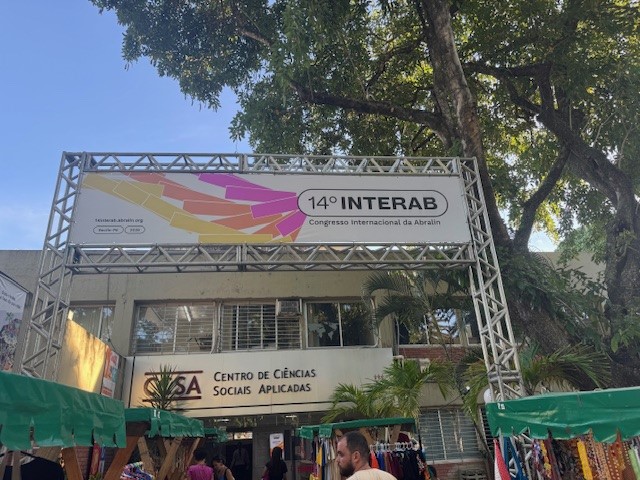
The 14th ABRALIN International Congress (INTERAB) took place from March 2 to 6, 2026, at the Federal University of Pernambuco (UFPE), in Recife. Theme: “The challenges and advances in language studies in a changing world”/“Os desafios e avanços nos estudos da linguagem em um mundo em transformação”.
Frieda Steurs, Secretary-General of CIPL, had the privilege to attend the conference as an invited speaker. It was an incredible experience, with more than 2000 enthusiastic linguists, researchers and students who attended this event.
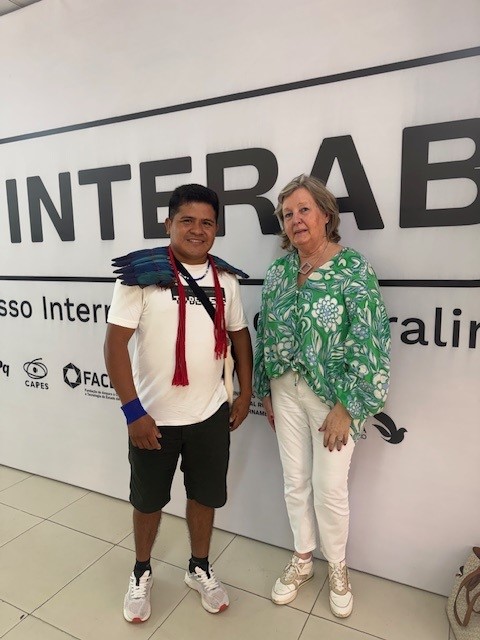
Frieda Steurs and Travel grant winner Valdeano Faustino Pompeu Guajajara
For the first time, the event was held in a hybrid format, combining face-to-face activities with online broadcasts and debates on a virtual platform. This format was chosen to increase accessibility and encourage the participation of researchers from different regions of Brazil and abroad, fostering greater collaboration and knowledge exchange within the academic community. The initiative reflects ABRALIN’s commitment to adapting to new demands and making scientific knowledge more inclusive and comprehensive.
The central theme of the event was the challenges and advances in language studies in a changing world.
The event brought together researchers, teachers, students and others interested in the area to debate the latest developments in the language sciences.
The programme included conferences, round tables, oral and poster communications, research panels and satellite events, promoting the exchange of knowledge and the strengthening of research networks.
ABRALIN is currently organized into Thematic Commissions (TC), which bring together researchers to promote academic articulations and hold meetings in their respective areas. In total there were 31 areas, reflecting the diversity and scope of linguistic studies. These thematic axes served as a reference for the submission and presentation of papers, promoting debates and reflections on different perspectives and approaches in the field:
1. Literacy and Language Development
2. Discourse Analysis
3. Language Acquisition
4. Lexical Studies
5. Dialectology
6. Diversity, Equity and Inclusion (DEI)
7. Language Teaching
8. Phonetics
9. Phonology
10. Historiography of Linguistics
11. Endangered Languages
12. Sign Languages
13. Indigenous Languages
14. Applied Linguistics
15. Computational Linguistics
16. Corpus Linguistics
17. Language and Cognition
18. Linguistics and Basic Education
19. Linguistics and Olympiads
20. Historical Linguistics
21. Linguistics in Undergraduate Education
22. Text Linguistics
23. Morphology
24. Neurolinguistics and Psycholinguistics
25. Language Policy
26. Popularization of Linguistics
27. Semantics and Pragmatics
28. Semiotics
29. Syntax
30. Sociolinguistics
31. Translation Studies
I presented a lecture on the topic: Intelligent Language Technology: AI and the Impact on Languages and Language Policy, and took part in a debate on the policy of linguistic organizations in South America and the role of CIPL.
CIPL had taken the initiative of opening the travel grants programme for the attendees of this conference. Five excellent papers were selected by a special jury, all dealing with indigenous languages.
The EC of CIPL wants to congratulate the organizers of this conference with the excellent organization, in a very stimulating environment for students and young scholars.