
On 20 January 2026 Deborah (Debbie) Cameron, Professor Emerita at the University of Oxford, passed away. She was only 67 and had recently retired from her Rupert Murdoch Professorship in Language and Communication held at Worcester College. Although she may not have been very active in societies linked to CIPL, her work will have influenced many individual members of our member societies around the world. Professor Cameron was and continues to be an internationally renowned sociolinguist (in the broadest sense of the word) best known for her most incisive and often pathbreaking works about feminism, gender and sexuality.
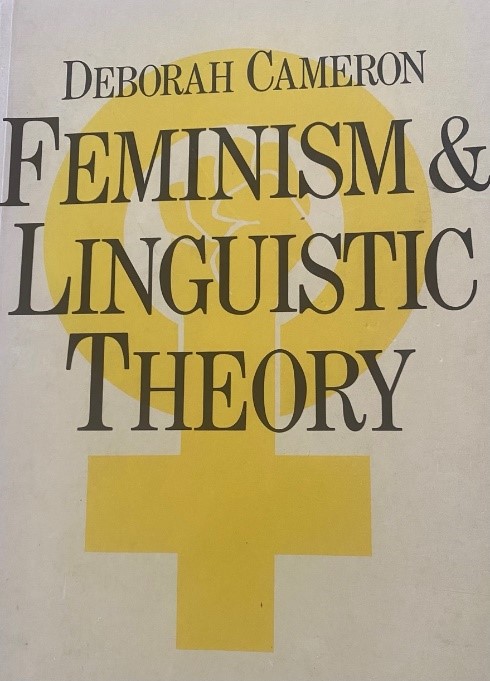
Her book Feminism and Linguistic Theory was published in 1985. It became a crucial, and for some the crucial text around which feminist linguistics was shaped. In fact, it became a ‘bestseller’ (probably not a term Debbie would have liked) that featured not only on all courses dealing with language and gender but also reached a feminist readership beyond academia and language studies. Those familiar with Debbie’s academic trajectory will be aware that this publication showed her resilience in pursuing feminist academic writing despite rejection. The topic of her book had been rejected as a suitable thesis proposal by Oxford University. Debbie left Oxford without a PhD, but with an idea and proposal that would shake up linguistic work around gender worldwide. In my 40+ years of supervising and examining master and doctoral dissertations around gender, not a single one did not cite or quote from this work. I had the pleasure of meeting Debbie a few months after the book was published in 1985. In fact, I was sitting on a London bus on my way to giving a lecture at Roehampton Institute of Higher Education (now Roehampton University) about language and gender research in Australia. She attended the lecture and afterwards we had a chat in which she (very casually) mentioned her book. Being based in Australia in the 1980s meant that academic books took much longer to be publicised, let alone arrive here! I bought the book that evening and started reading and rereading it several times during my stay. There is no doubt that it had a significant influence on my own work in this field. While the vast geographical distance between our places of work restricted regular get-togethers, we did manage to catch up at various congresses, workshops, symposia in the US, UK, Denmark, Sweden and… Australia (the latter was a major feat as she did not like flying, certainly not long distance!!!). Debbie’s influence did not rely on this one ‘great’ work. Not only did she write many more books and articles that touched upon gender issues within language (e.g., Language and Sexuality – with Don Kulick – 2003; On language and sexual politics 2006; Language, sexism and misogyny 2023 ) and within society (e.g., Feminism 2019, Gender, power and political speech – with Sylivia Shaw – 2016), her academic writing also included contributions to research methodologies, discourse analysis, grammar teaching. Furthermore, she was an activist who did not shy away from talking and writing about ‘tricky’ issues around notions of gender (binary vs non-binary), about gender-based discrimination, about (promoted) gendered stereotypes of talk. With these she reached an audience far beyond academia. Notable examples here are The Myth of Mars and Venus: Do women and men really speak different languages? (2008) that critiques the premise of John Gray’s immensely popular book “ Men are from Mars and Women are from Venus” (1992), and Good to talk: Living and working in a communication culture (2000), a critical look at the upsurge in the promotion by large companies of specific kinds of talk that ‘benefit’ the culture of the workplace. Her sharp intellect, quick wit, dry humour combined with a willingness to speak out about ‘difficult’ or ‘controversial’ social issues beyond academia made her a public intellectual, a ‘breed’ of academics that is becoming increasingly rare in a communication world dominated by influencers and AI bots. Vale, Debbie.
Anne Pauwels, President CIPL, Prof. Emerita of Sociolinguistics, SOAS University of London/Hon Professorial Fellow, University of Melbourne